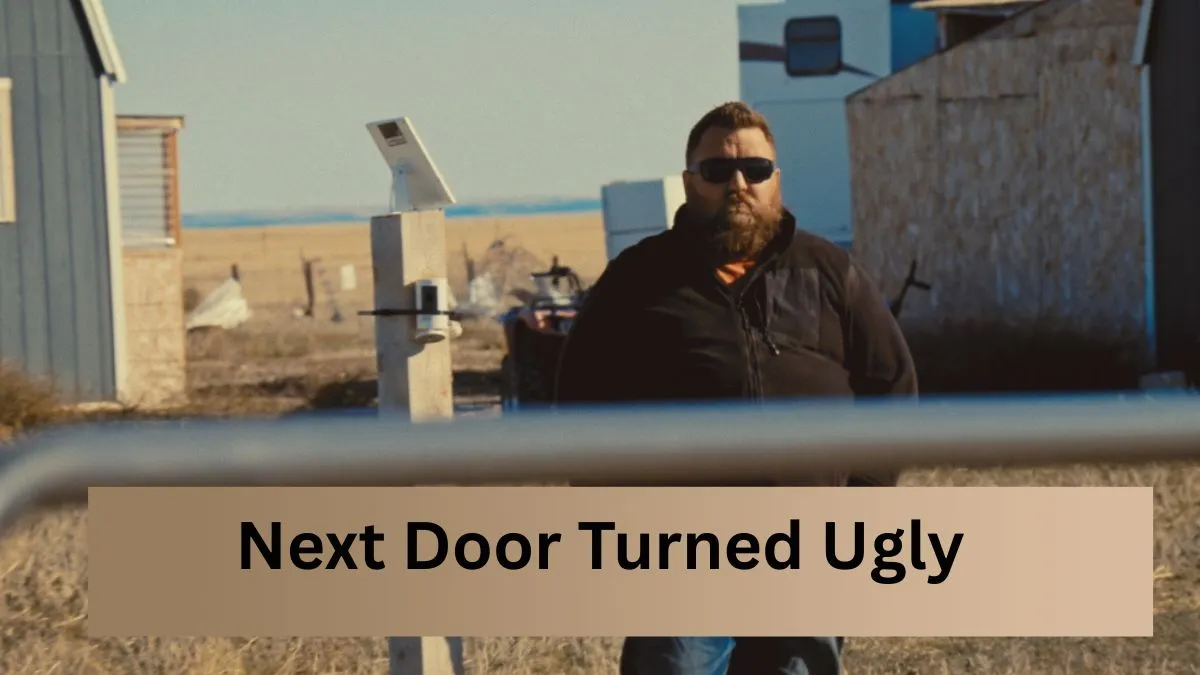
In an era where neighborhood drama often unfolds on apps before it reaches the sidewalk, HBO’s latest docuseries feels eerily familiar.
“Neighbors,” executive produced by Josh Safdie, transforms everyday property disputes into gripping, character-driven television — and in the process, captures something deeply American about pride, ownership and online outrage.
A Docuseries Rooted in Modern Conflict
Each episode of Neighbors opens with a sweeping shot from outer space, slowly zooming into a specific corner of the United States. The symbolism is deliberate.
From Manhattan apartment buildings to Montana ranchlands and suburban San Diego, the six-part HBO series explores clashes between neighbors who believe — with absolute certainty — that they are in the right.
The disputes range from lawn boundaries and shared driveways to ideological conflicts and zoning wars. Yet beneath the surface arguments lies a deeper theme: the American fixation on property as identity.
The result is a docuseries that feels like Nextdoor brought to life — but filtered through the anxious, kinetic energy of the Safdie filmmaking style.
Read More: Friday the 13th 2026: Origins of the Superstition and How Many Dates Are Coming
The Safdie Effect
Josh Safdie, best known for co-directing Uncut Gems and the Oscar-nominated Marty Supreme, brings his signature fascination with eccentric personalities to the nonfiction format.
Following his creative split from brother Benny Safdie, this marks one of his first high-profile solo television efforts. The series is also backed by A24, reinforcing its prestige credentials.
Fans of the Safdie brothers’ scripted work will recognize familiar DNA: morally complex characters, escalating tension and an unfiltered look at people pushed to emotional extremes.
Only this time, the stakes aren’t gambling debts or criminal schemes. They’re fences, gates and front yards.
Bigger Than a Boundary Line
What makes “Neighbors” compelling isn’t simply the absurdity of the conflicts — though there is plenty of that.
A former stripper turned suburban homeowner feuds with a neighbor over a lawn display. A Montana homesteader wages digital warfare against the man who installed a gate on a private road. In Florida, a glitchy mapping app sends beachgoers onto private property, sparking outrage.
The disputes often spill into social media, courtrooms and comment sections. Ring cameras, cell phones and livestreams become both evidence and ammunition.
The show argues — without heavy-handed narration — that surveillance technology and online exhibitionism are amplifying disputes that once might have been resolved quietly.
Why ‘Neighbors’ Feels So Timely
At a moment when Americans are increasingly polarized, “Neighbors” zeroes in on hyper-local conflicts that mirror broader cultural tensions.
Property rights, personal freedom and public space are hot-button issues far beyond the driveway.
The series also taps into a familiar digital pattern: grievance going viral. Many of the participants initially caught the attention of directors Harrison Fishman and Dylan Redford after posting their disputes online.
In this way, “Neighbors” doesn’t just document conflict — it examines how technology fuels it.
Not Always Comfortable — Always Compelling
Unlike other Safdie-produced docuseries such as Ren Faire or Telemarketers, which center on a single dominant personality, “Neighbors” weaves multiple stories into each episode.
This pacing creates a collage of American eccentricity.
Some stories are darkly funny. Others feel unsettling. A few are surprisingly poignant.
The least satisfying conflicts tend to involve one clearly unreasonable party facing off against more levelheaded neighbors. The most fascinating episodes feature evenly matched adversaries, locked in cycles of pride and stubbornness.
In one standout moment, a woman’s adult son bluntly calls his mother’s feud “one of the dumbest arguments I’ve ever seen.” Ironically, the only person who shares her obsession with locating the exact property line is her sworn enemy.
It’s absurd — and painfully human.
A Portrait of Contemporary America
Beyond entertainment, “Neighbors” functions as a sociological snapshot.
The American flag imagery in the opening sequence is no accident. The series suggests that this uniquely combustible blend of homeownership ideals, litigious culture and online amplification could only exist in the United States.
Homeownership, long considered a pillar of the American Dream, becomes both aspiration and weapon.
In that sense, “Neighbors” is less about lawns and more about identity.
Final Verdict: A Must-Watch for HBO Fans
HBO has built its reputation on character-driven storytelling, and “Neighbors” continues that tradition in nonfiction form.
It may not always be comfortable viewing, but it is undeniably engrossing.
For audiences who appreciated the tension of “Uncut Gems” or the eccentric personalities showcased in other Safdie collaborations, this series delivers a similar rush — grounded in real life.
As neighborhood disputes increasingly play out on screens rather than sidewalks, “Neighbors” feels less like a spectacle and more like a mirror.
And that reflection may be the most unsettling part of all.
Would you confront your neighbor — or hit “record” first?

Saqlain is a creative digital content creator with over 5 years of experience in producing engaging and visually unique content. With a strong focus on originality and storytelling, Saqlain continues to share meaningful moments that connect with a growing audience online.